Alice Walker’s novel The Color Purple was published in 1982. It became a bestseller and won the Pulitzer Prize, and in the years since its author has become accepted alongside Zora Neale Hurston and Toni Morrison as one of the pre-eminent American novelists, particularly among those who tell the stories of early twentieth-century African American women. The big-screen adaptation was released three years later. The Color Purple was a challenging adaptation project in many ways. The story is told in a series of letters, most never sent, many addressed to God. The movie, perhaps inevitably, misses many of the complexities and deeper themes of the novel; however, it still emerges as a valuable depiction of a time and experience often ignored in the movies.
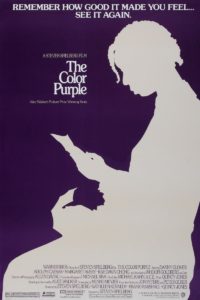 The story centers on Celie (played as a child by Deserta Jackson, and as an adult by Whoopi Goldberg), whom the world has surrounded with cruelty. She is abused by her father, and then married off to a brutal man she refers to only as Mister (Danny Glover). She is separated from her beloved sister Nettie (Akosua Harris). But everything changes for Celie with the arrival of Shug Avery (Margaret Avery), the worldly blues singer her husband has been crazy about for years. A deep friendship develops between the two women; with Shug’s guidance, Celie begins to awaken to possibilities of self-love and independence.
The film was directed by Steven Spielberg, and it marked the beginning of the director’s dramatically serious endeavors. Spielberg’s tendencies toward overstated sentiment and lack of nuance are largely absent from The Color Purple. He maintains a steady directorial hand, allowing the performances to shine and carry the day. It is Goldberg, an unknown at the time, who is the real revelation. It is no easy feat to convey the feelings and thoughts of a woman who is rarely allowed to speak, but Goldberg manages to grant Celie a deep inner life, initially suppressed and later allowed to blossom into full life. Goldberg’s subsequent career has predominately been as comedienne; The Color Purple serves as an example of what powerful dramatic actress she could be. It is a similarly pleasant surprise to see a pre-mega fame Oprah Winfrey as Sophia, the outspoken wife of Mister’s oldest son. Difficult as it is may be now to not see Oprah as Oprah, Winfrey delivers a very capable performance that serves as the complimentary dramatic trajectory to Celie’s. Sophia is assaulted by circumstance and tragically loses her strength, whereas Celie gradually gains a voice and strength as the story progresses.
Readers of Walker’s novel will note, and possible bridle, at the tonal and narrative shifts and omissions that the film makes. The novel deals much more frankly with sexual matters, and Nettie’s journey in Africa is practically a footnote rather than the fully-developed plotline it is in the book. But even with the concessions and differences, the film of The Color Purple still serves as a fine companion piece to the novel. •