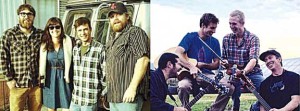
 Diverse as it is, the Bozeman music scene is regularly faced with a familiar dilemma. People are bound to follow numerous acts with so much musical talent condensed into our little mountainside metropolis, no matter how often or infrequent their shows come along. This is a place where live music remains one of the biggest draws for enthusiasts and regular ole fun-seekers alike. Local groups Laney Lou and The Bird Dogs and Hollowtops are teaming up for a dual show that promises to bring the music, the energy, and the fun to a single stage, Friday, April 22nd at the Filling Station beginning at 10pm.
Based out of Bozeman, Laney Lou and The Bird Dogs have become a local favorite and a staple of the Montana folk scene. The Bird Dogs have a full summer lineup planned, with Headwaters Country Jam and Red Ants Pants Festival topping the list. In support of numerous notable touring acts, as well as having played some of Montana’s best venues, 2015 saw The Bird Dogs come into their own. Now in the editing process, The Bird Dogs hope to release their debut album in May of 2016. The Bird Dogs is comprised of Lena “Laney Lou” Schiffer with vocals, guitar, and washboard, Ethan Demarais on bass, Brian Kassay with fiddle, mandolin, vocals, and harmonica, and finally Matt Demarais with vocals, banjo and guitar.
From the very first time Alex, Bridger, Max, and Max played music together in the Fall of 2013, there was instantaneous musical chemistry. Drawing from an array of musical backgrounds, Hollowtops fuse together bluegrass, rock ‘n’ roll, classical, and jazz in engaging compositions. Reigning from a Montana town with a spirited appreciation for bluegrass, it is no wonder that the Hollowtops captivate audiences with their sound and presence. Having shared the stage with Elephant Revival, Pert Near Sandstone, The Lil Smokies, Dead Winter Carpenters, Kitchen Dwellers, and more, Hollowtops are lifting off into the Montana Bluegrass scene. Hollowtops is comprised of Alex Koukov on banjo and vocals, Bridger Dunnagan with fiddle and vocals, Max Davies on guitar, and Max Johnson on bass. In anticipation of their upcoming show, the Rolling Zone was able to sit down with Lena, Alex, and Bridger to chat about “newgrass,” creating and playing music in a small town, and what they really think of each other. It’s honestly not as bad as you might think.
RZ: You’ve got a show coming up at the Filling Station on April 22nd. What can we expect from the Bird Dogs and Hollowtops teaming up? LS: We happen to like each other and have pretty similar friends, so, in my mind at least, it’s going to be a pretty sweet show. They have friends that probably haven’t seen us and we have friends who haven’t seen them, but they all probably know each other somehow because it’s Bozeman. We’ll get a lot of local people out.
RZ: Do you guys have anything in particular planned for the show? BD: Maybe a few days before, we would be like “Hey, do you want to play this song with us?” or something like that and we would figure it out– AK: We’d have all the intentions to practice, but it wouldn’t happen. There’s no way to make that happen. LS: There’s always the old traditional tunes, especially in bluegrass, that a lot of people know. Also, even if you don’t know it, the chords in bluegrass songs tend to not be that difficult. We can improvise that way. I bet that will happen. BD: Both of our bands are rooted in traditional music, so they’ll call out and name and we’ll know it, or I’ll know a fiddle kick to it. The genre lends itself for sit-ins for that reason. You just call out a traditional name, [in bluegrass] and people know it. [It’s] really cool. LS: It doesn’t really happen in other genres the same way.
RZ: How much time do each of your bands devote to practice between shows? LS: We practice quite a bit. We’re trying to get away from the traditionals. When we were first a band, we were trying to come up with a solid set list, so we spent a lot of time learning covers mostly of traditional tunes so we would have something to play when we were out. But now we’re working really hard on getting mostly originals. We have a lot of shows this summer that are 45 minute to an hour sets at different festivals. We want it to be a solid hour of just our best original music. For us, we’re leaning on more like two practices a week, which is a lot when we all have full-time jobs. [But] it takes a long time to write songs and get them solidified. We see each other a lot. BD: Hollowtops is not that way. I’m jealous you guys practice two times a week. LS: We’re trying to practice. We see each other two times a week. BD: In the first year, we practiced a lot. Definitely weekly. As [Lena] was saying with building your set, you kind of learn a set of material. For us, we kind of did that for the first few years. In the past year or so, [we’ve] kind of eased off on the practicing.
RZ: It seems like once you have some stuff down, it’ll come pretty naturally. AK: [We’ve] got like three hours of music that’s all practiced and we’re not going to forget ever. We play music, the four of us, whether it’s a gig or a practice, probably once a month is how often we play together. BD: Together. The four of us as Hollowtops. AK: Which sucks, but it’s just how it is. Two of us have day jobs and two of us go to school full-time. All of us have other [musical] things going on as well. We’re all very busy. We really love playing music together, but we just don’t really get to it very often. It kind of makes it really special when we do get to play together. BD: There are a lot of songs that I wrote or that other members wrote that I only play when we’re performing, which is kind of bizarre. That’s different than most bands, I would say. AK: The cool thing about that is, since we don’t practice them, they get to be something different every time now. Sometimes, they get to go to weird places they’ve never been before. I think that’s a bonus of not practicing together. New things totally happen with the music we practice by ourselves. BD: We know what our sound is like and we know what everyone likes, so our practice time is a lot more efficient. We’ll get together before a gig and get a couple new things, maybe run over old things, but that’s kind of what our practice looks like. LS: Our band is trying really hard to work on adding music. Sometimes people will comment and say, “Do you guys have new songs?” I don’t think people realize how much time it takes to add more songs to your set. The background of learning new music is tougher than people think, especially when you’re doing original stuff. We have like eight songs on the back burner of original material that are ideas right now. To actually make [those] song[s] forward is hard. They’re all ideas that are solid and I think we’re all into, but it does take a while to make it become what people enjoy listening to. [And] when you have four opinions, it takes even longer.
RZ: So we’ve somewhat touched on this, but originals versus classics. Is there a preference of playing one or the other with either band? How also would you describe your sound? AK: We really like covering pop songs. It’s really fun. LS: Totally. BD: We play bluegrass music, but we all listen to tons of different kinds of music. Our bass player is a classical musician, our guitar player is into jam music, Alex and I are into lots of things as well. AK: Mostly things that begin in blue- and end in -grass. BD: We see the same qualities in music that we like, in any music, 80s pop being one of those. It’s a really engaging process to take an 80s pop song and say, “What is the synth doing, what’s the bass line here,” and dissecting it– AK: –How can I make my banjo sound like a synth? BD: And regurgitating it into a bluegrass scenario. How can I make my fiddle sound like a horn set? That’s probably the most fun I have with Hollowtops. LS: Those are really fun, because the traditional bluegrass [songs] have been covered a million times. It’s hard to make it sound that different. We do a cover of a Black Keys song and it’s one of our favorite ones to play, and similarly, make the fiddle sound like a guitar solo. It translate[s] really well into a bluegrass vibe. None of us have strong bluegrass roots. I think, for your guys’ band too, that almost adds something different to it. People have heard bluegrass bands before, it’s kind of fun to come at it with a different attitude a little bit. BD: Bluegrass bands in this day and age also can’t just play bluegrass. LS: To keep someone’s attention. AK: It’s not financially viable if you’re trying to do music for a living. LS: It’s been done. David Grisman, Sam Bush, Tony Rice–all of them have done it so well, how are you going to compete with that? AK: It’s still fun, but if you’re not making money, you can’t do it. People don’t want to pay money to listen to [what sounds] the same. Bridger and I are happy to listen to traditional bluegrass for hours and love it and really dissect the music, but to someone who just likes to listen to music and go to shows, it’s not necessarily enjoyable. LS: They need something to be entertained by. We definitely hesitate to say we’re a straight-up bluegrass band. You look at our instrumentation and we do cover traditionals, but we’re not jamming out, we’re not pickers necessarily. That in itself gives our band a little bit different of a vibe and it’s less traditional because of that. BD: Where the word “bluegrass” started from is decades away. In those decades, you have all these different genres–jazz, rock, blues. With every different American genre, you have, in a lot of ways, that equivalent of bluegrass. You have popgrass, jazz with bluegrass instrumentation, jam band-grass, everything. AK: We have a friend that considers a couple of band EDM-grass. LS: Bands are just having to cater to this audience that has been handed a lot of options for music. You need a lot of stimulation. It’s gotten a little bit away from the simplicity of the blues. It’s almost like now, our bands, are having to make things more complicated [to] cater to this audience who wants more. They don’t want just the simple blues. AK: You can’t only think, “What kind of music do we want to make?” one hundred percent of the time. You can play music for yourself all you want in your living room, in your bedroom, but when you’re performing, you’re playing for other people. You have to make music that is conscious of the audience.
RZ: It’s got to be pretty satisfying when people respond well to your music, whether it be an original tune or a rendition of a classic. LS: One of the most satisfying things for our band is when people respond to an original song we’ve written just as well as a cover. BD: Or more. LS: Or more. And a lot of times, they don’t know it’s an original. That’s a compliment, because they’re jamming out and dancing to that as if they’ve heard it a million times.
RZ: How receptive has the Bozeman/Southwest Montana music scene been to your music? LS: If you had told me four or five years ago before I moved here that I was going to be in a bluegrass band in Bozeman, Montana, and actually made it to as far as we have, I probably wouldn’t have believed you. I think it’s great being in a smaller town versus Nashville or Austin, because you have a smaller, more focused group of people who are going to hear you and spread the word. There [are] great communities in Montana. I think people here are just stoked about good music. A bigger city absolutely has more to offer. As far as getting your name out quickly, I think it happens a little quicker in a smaller town and then you can grow from there. BD: The Kitchen Dwellers are making now, who started here as a small bluegrass band like us. They worked at what they did and now they’re a nationally touring act. That happened in a few years. AK: It’s really fun, but [can be] tough. In one weekend, we [can] oversaturate and people aren’t going to come to our shows in a month. If you live in a city like Denver [or] Seattle where there’s a lot more music going on, there’s a lot more people to play with–and there are some really great musicians to play with here, but there are way more of them in other places. LS: It’s really easy to oversaturate your shows in Bozeman. You’re relying on your fans coming to those shows. We definitely did the same thing. In the last year, we realized we needed to space our Bozeman shows out a little more, so that the shows, like with the Hollowtops on the 22nd, [are] going to bring a lot of people out.
RZ: Nice plug. LS: When you’re starting out with a band in Bozeman, it’s great. You get your name out and you have diehard fans and it’s awesome. BD: And that process is so exciting. You see your bands building and more and more people come, and in a small town, your name spreads like wildfire. LS: It’s sort of funny, because we (The Bird Dogs and Hollowtops) started around the same time. I remember we were a little bit competitive with you guys. Like, “Oh, the Hollowtops got a show at the Filling Station? We’re going to get a show at the Filling Station.” That was good motivation. BD: I remember we opened for you guys at the Murray. LS: Oh yeah. BD: You asked us and we were like, “Sure, why not.” LS: I think that’s kind of what makes this show fun. We did start at the same time, so we’ve been able to see each other’s bands grow at the same time and that’s been really interesting. [Our bands] are young and cater to a similar crowd, but we’re different enough also. We’re different enough bluegrass bands to play together. BD: This’ll be fun. Let’s try to explain each other’s bands. Do you want to do that?
RZ: Yeah. Let’s do it. That sounds like a really great idea. LS: [laughing] You go first. BD: Laney Lou is like stomp-grass, if I was going to put a name [to it]. It gets people moving. Their fiddle player, Brian, is the most animated fiddle player and he just shreds. He’s like an electric guitar player, shreddin’ on the fiddle. So stompgrass comes to mind. [Their originals] are very outlaw. LS: We talk a lot about killing people and running away. BD: It’s just super high-energy and really fun to watch. LS: That’s funny. AK: I like this game. Yeah, people don’t go see Laney Lou and the Bird Dogs just to listen to their music. They go to watch them play because it’s so much fun to watch them play. You could mute them, and still have a good time watching. But then, the music’s great too. There [are] a lot of different dynamics coming into play. BD: [Their] stage presence envelops the whole venue, which is cool to see. LS: The biggest comment we get from people about our music is that they see that we are having fun on stage, and that is infectious. And therefore they want to have fun, too.
RZ: Ok. Your turn. They’re ganging up on you. LS: This isn’t fair that it’s just one person, me, having to explain your guys’ band. I would say, about the Hollowtops, what I notice and what I notice from the audience watching them, they get really creative with their songs. They will take a Kesha song and turn it bluegrass, but they do it really well. They don’t just play the basic notes, they actually put the bluegrass into that song and I think the audience really loves that. They can see that this is not just a traditional bluegrass band. They’re very musically talented. All four guys in that band are extremely talented. They’re tight and the singing is amazing. I think the creative part is probably my favorite part of your band. You can see the wheels turning in their heads. The audience watching a Hollowtops show gets a really solid mix of traditional bluegrass and creative newgrass we’re talking about.
RZ: Sounds like it’s going to be an awesome show. Good luck, guys.
Come see them in the act! Laney Lou and The Bird Dogs will take stage alongside Hollowtops on Friday, April 22nd at the Filling Station beginning at 10pm. Tickets to this 21+ show are just $7 and available at the door. Doors at 9pm. •