Professor Christina Z. Anderson explains the art and science of alternative photo processes
by Carol Schmidt, MSU News Service
BOZEMAN – When it comes to transformation, Montana State University photography professor Christina Z. Anderson is a triple threat.
A noted artist and author, Anderson is an expert on alternative photographic processes and the magic that happens when art and science meet on a photographic medium. Through her own experiences, she has also become an authority about the impact of teaching — the alchemy she said can occur when a student’s life can be changed by the inspired meeting of opportunity and knowledge.
A professor in MSU’s School of Film and Photography in the College of Arts and Architecture, Anderson speaks about her art, her process, her teaching philosophy and her legacy during a Provost’s Distinguished Lecturer Series virtual event. A video of MSU Provost Robert Mokwa interviewing Anderson for the lecture will premiere at 7 p.m. Thursday, Oct. 29, on MSU’s YouTube channel, https://youtu.be/yL2cBGRxI-w.
Because of COVID-19 restrictions, this season’s Provost’s Distinguished Lecturer Series, the university’s eighth season, can be viewed online beginning at 7 p.m. Thursday, Oct. 29. Mokwa observed that one benefit from this change in format is that viewers have an opportunity to hear from MSU faculty like Christina Anderson in a less structured format. Rather than on the stage, behind a lectern, the audience can watch Mokwa’s in-depth interview with Anderson, interwoven with short segments of her working with students and demonstrating many of the non-traditional photographic processes for which she is internationally known.
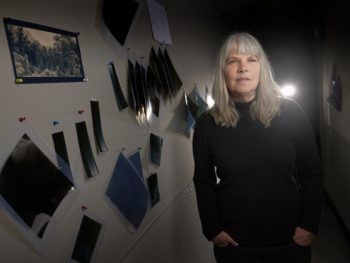
Provost Bob Mokwa will interview MSU photography professor Christina Z. Anderson for the Provost’s Distinguished Lecturer Series virtual event premiering at 7 p.m. Thursday, Oct. 29, on MSU’s YouTube channel, https://youtu.be/yL2cBGRxI-w. Anderson, a world authority on alternative photographic processes is a master teacher, author and artist. She is pictured in the alternative process lab in the School of Film and Photography Thursday, Feb. 20, 2020 in Bozeman. MSU photo by Kelly Gorham.
“This session with Christina Anderson is the first time we have tried this,” Mokwa said. “Viewers will find it interesting and informative as we pull back the curtain and join a scholar and teacher as she describes her artistry in a variety of non-traditional alternative photography processes. Christina also discusses her journey and how her work with students has influenced her pathway and lead to her successes as a teacher and artist. I think viewers will be fascinated.”
Anderson’s path to noted artist and scholar as well as award-winning professor began about 25 years ago just a few doors from the studio and low-light room in MSU’s Visual Communications Building where she now teaches and works. In 1995, she was a 40-year-old mother of five who had a bachelor’s degree in French from the University of Minnesota who wanted to take a painting class at MSU. One class led to more classes, including a photography class taught by John Hooton.
Another class taught by Rudi Dietrich, MSU professor emeritus in photography, introduced her to alternative process photography, often called “alt,” methods of developing photographs that were different from the standard Kodak processes of the time. Anderson still considers Dietrich to be one of her biggest mentors.
“I immediately knew that alt photography was what I would do with my life,” Anderson said. “Alt processes were like painting for me. It was hands-on photography.”
Anderson explains that photographs most of us are accustomed to seeing today are digital and computer processed. Anderson said alt prints are painstakingly made the old-fashioned way — by hand. Alt processes include gum, casein, cyanotype, platinum, ziatype, collotype and salt, among others. All are considered alternative because they are distinct from the modern black-and-white, silver gelatin and color processes.
Anderson became immersed in the form, earning a bachelor’s of fine arts in painting and another bachelor’s degree in photography from MSU. She taught black and white and experimental photography for MSU for three years and then went to Clemson to study with Sam Wang, who was at the forefront of the antique processes movement in the 1960s and 1970s. Anderson earned a Master of Fine Arts from Clemson in 2005 and returned to MSU, where she has been teaching since.
“My goal at the time was to put alt on the map,” she said. “It was not to only get accurate information about the processes out there, but to make it more visible in the photographic arts.”
An active artist, several of Anderson’s works, photographs of the “social and spiritual landscape,” hang in galleries and collections throughout the country.
Another serendipitous turn to her career resulted from a lack of printed materials about alt processes. Anderson said when the loose, photocopied handouts she made for her students became unwieldy, she combined the materials into a spiral bound notebook printed at MSU’s University Printing. That evolved into her writing textbooks on alt processes. She has since been involved in publishing five books on different alternative processes, co-authoring two more, and editing six books written by other authors, with one more book on the way. Her books are now sold in at least 40 countries.
She said she enjoys the writing process, which she calls a neat and controlled process different from other aspects of her career.
“You write things down and put them in a neat place.” she said. She also is passionate about teaching, which she said is uncontrolled in many ways and ultimately very fulfilling. An award-winning professor, Anderson is a frequent recipient of MSU’s Teaching Excellence award, and this year she was the recipient of the James and Mary Ross Provost’s Award for Excellence.
“Students are wildcards,” Anderson said. “You don’t control them. You give them the tools(then) they go off and who knows what they will do.” She said her goal in teaching it to help her students become better photographers and artists than she is, and she believes many of them have. Anderson estimates at least a dozen of her students are now teachers with another contingent working as photographers or artists.
“I have been very blessed to be at the right place at the right time,” Anderson said. “Where I go from here, I don’t know. I know I will just keep saying yes. That’s what has led me here.”
Anderson’s MSU Provost’s Distinguished Lecturer Series video may be accessed beginning at 7 p.m. Thursday, Oct. 29, on MSU’s YouTube channel, https://youtu.be/yL2cBGRxI-w. •