From MSU News Service
Blake Wiedenheft, an associate professor in Montana State University’s Department of Microbiology and Immunology in the College of Agriculture and College of Letters and Science, will present “The Art and Ethics of Genome Surgery: A Citizen’s Guide to Understanding a Revolutionary New Technology” at the next Café Scientifique. The event, which is hosted by MSU’s Montana INBRE and COBRE programs, will take place at 6pm on Wednesday, May 15th, at the Emerson Center for the Arts and Culture in Bozeman. It is free and open to the public.
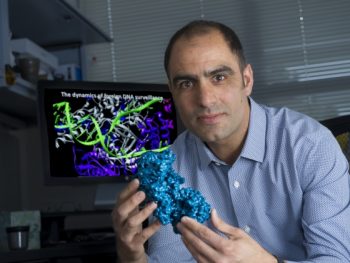 Wiedenheft, whose MSU-based lab utilizes genome-editing technology known as CRISPRs, will provide an overview of CRISPRs’ biological role in bacterial immune systems and how scientists have repurposed it to rewrite the genetic code.
“Bacteria have a sophisticated adaptive immune system that fight off viruses by selectively snipping the viral DNA into useless fragments,” he said. “It is incredible to reflect on how our basic interest in understanding what happens when bacteria get infected with viruses has led to a new technology that enables genetic reprogramming in plants and animals, including humans.”
In addition to providing insight into the technology’s origins, Wiedenheft also intends to summarize the ways in which scientists have been using the technology to open up promising new areas of research impacting human health.
“I think there are controversial and non-controversial applications of CRISPRs in agriculture and medicine, but I think it’s important to understand what is being done and how, which will help inform opinions,” he said. “CRISPRs are quickly starting to impact many aspects in our lives and it’s important that we look ahead.”
Despite the technology’s potential for good, Wiedenheft is acutely aware that the power to pinpoint and selectively alter DNA raises new and increasingly consequential ethical considerations.
“With any transformative new technology comes an awesome responsibility,” he said. “The same technology that could one day cure cancer or any number of other genetic diseases could also be used to selectively eliminate certain species from the face of the Earth, and that’s nothing to be taken lightly.”
Wiedenheft said that policies governing uses of this technology should be determined by an informed public.
“It’s rare that experimental science transitions so quickly into the public, but we all have a responsibility to be part of this transition, and the public needs to know enough about gene editing technology to evaluate risks and benefits. We need policies that align with this risk tolerance and ethical boundaries.”
Originally from Fort Peck, Wiedenheft has established himself as a leading researcher in the study of CRISPRs, which have been transforming biomedical sciences by providing new tools for programmable manipulation of DNA. After completing his doctorate at MSU in 2006, Wiedenheft continued his research at the University of California, Berkeley in the lab of Jennifer Doudna, professor of chemistry and molecular and cell biology. His work there helped to uncover a sophisticated adaptive immune system in bacteria that relies on a programmable molecular scalpel that protects bacteria by specifically chopping up invading viral DNA. In recognition of his cutting-edge research at MSU, President Barack Obama awarded Wiedenheft with the 2017 Presidential Early Career Award for Scientists and Engineers.
Café Scientifique provides a relaxed setting for people to learn about current scientific topics. The concept started in England in 1998 and has spread to a handful of locations in the United States. Following a short presentation by a scientific expert, the majority of time is reserved for conversation, questions and dialogue. Free refreshments are provided.
Housed at MSU, Montana INBRE and COBRE are each Institutional Development Award Programs (IDeA) from the National Institute of General Medical Sciences of the National Institutes of Health under grant numbers P20GM103474 and GM103500, respectively.
Contact Bill Stadwiser with Montana INBRE at (406) 994-3360 or william.stadwiser@montana.edu for more information about the Café Scientifique concept or check the web at inbre.montana.edu/cafe/index.html.