How did a quaint tale of wronged peasants, dastardly noblemen and jilted ghosts become one of the greatest ballet classics of the 19th century?
It was a period when Europe was immersed in ballet-mania. Middle-class audiences delighted in the fashionable Romantic art form and electrified fans argued over rival claims of leading ballerinas. Female dancers were portrayed as exotic concubines, bi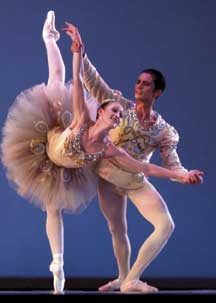 g-eyed gypsies and adorably sweet peasant girls. Most seductively, they appeared as ghosts and sylphs, seemingly floating across the stage aided by their new-found skill of dancing on the tips of their toes and the supernatural effects of recently installed theater gas lighting.
After Giselle debuted in 1841, the character of Giselle became so popular that clothing, hats, and souvenirs were named after her. And Carlotta Grisi, the Italian ballerina who first played the part, became one of the highest-paid dancers of her time.
There was such demand for the production that clones of Giselle were created in theatres all over Europe and North America. But unlike other nineteenth century hits that withered away, Giselle survived to join the classical canon. Credit for its longevity goes to its precise synchronized choreography by ballet master Perrot-Coralli, an atmospheric musical score by Adolphe Adam, and a heart-wrenching libretto of Slavic legend by Gautier.
It tells of a young village girl who falls for the charms of a duplicitous nobleman disguised as a peasant. When Giselle discovers Albrecht’s true rank (and, worse, the existence of his aristocratic fiancée, Bathilde), she goes mad with grief (in the famous “mad scene”) and dies. Then she joins the ranks of the Wilis (the spirits of other jilted women), who take their revenge on faithless men by forcing them to dance to their deaths in the middle of the night. Giselle is delegated to finish off the penitent Albrecht, but she manages to keep him alive until dawn, when the sun’s rays force the Wilis to slink back to the darkness of their graves.
Pivotal to its plot is the barriers of class distinction, as an aristocrat and a peasant fall in love. But there is an equally profound conflict at work between male and female loyalties, with the Wilis Spirits claiming Giselle as a warrior against faithless men and forcing her to vacillate helplessly between her love for Albrecht and her duty to her sex.
The role of Giselle has been called “the ballerina’s Hamlet” and is regarded as one of the most difficult in ballet due to the intensely dramatic nature and technical skills required. French ballerina Mathilde Froustey, a Varna gold medalist, Paris Opera Ballet Sujet (soloist) and San Francisco Ballet principal dancer, performs the title role in Yellowstone Ballet Company’s Giselle. Mathilde won an Isadora Duncan Dance Award for her performances of Giselle with Tiit Helimets in 2015. The San Francisco Chronicle sums up her dancing: “She has brought a quicksilver technique, a pliant torso, witty musicality, pinpoint articulation and sheer élan to everything she has danced, from the 19th century classics to Artistic Director Helgi Tomasson’s newest work. Froustey looks delicate, but hers is the strength of spun steel.”
Nikita Kusurgashev, former soloist with the Bolshoi Ballet plays Giselle’s rejected suitor, Hans; Parsifal Pittendorfer of Texas Ballet Theatre, dances the nobleman Albrecht; Maya Moody of Bozeman dances the Queen of the Wilis and Erin Lane and Michelle Kolodin perform the Wilis lieutenants with a corps de ballet from Raison D’etre Dance, Yellowstone Ballet Company, and School of Classical Ballet, Billings.
Yellowstone Ballet Company’s production of Giselle comes to Bozeman’s Willson Auditorium on Thursday, June 14th at 6:30pm and Friday, June 15th at 7:30pm. Tickets are available at Eckroth Music and www.yellowstoneballet.info. Tickets range $25–$75 and will also be available at the door for an additional $2.

NO KINGS




INDIVISIBLE

Training

BoB 25

Click for Winners!
040126 BoZone

DOWNLOAD
04-01-26 PDF
The Revolution




Bruce Springsteen – Streets Of Minneapolis