From MSU News Service
A Stanford University neuroscientist will discuss the connections between disruptions in various systems in the brain and mental illness, along with existing and novel treatments, at a lecture on Thursday, May 2nd at Montana State University.
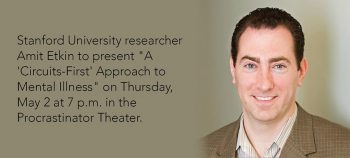
Amit Etkin, a professor in Stanford’s Department of Psychiatry and Behavioral Sciences and a member of the Wu Tsai Neuroscience Institute, will present “A Circuits-First Approach to Mental Illness” at 7pm in the Strand Union Building’s Procrastinator Theater. The lecture is free and open to the public. A reception will follow in the Leigh Lounge.
Over the past two decades, neuroimaging studies have defined a set of distributed brain systems that contribute to cognition, emotion, mood and other mental processes. Perturbations in these circuits have been identified in connection with psychiatric disorders. Etkin will discuss neural circuit abnormalities associated with psychiatric disorders as a whole, as well as specific changes associated with particular mood and anxiety disorders.
Etkin will also review current medication, psychotherapy and brain stimulation treatments in light of this understanding of brain circuits. He will describe new methods for direct, non-invasive probing and manipulation of circuits and the insights these offer for developing new circuit-targeting therapies.
Etkin is trained as both as a neuroscientist and psychiatrist. The goal of his lab is to understand the neural basis of emotional disorders and their treatment and to better understand how the brain works and to develop novel treatments. He said the aim is to take us beyond the use of symptom checklists for diagnosis and one-size-fits-all treatments that are currently available.
Etkin has received many awards for his work, most notably the NIH Director’s Pioneer Award in 2017 and the Joel Elkes Research Award from the American College of Neuropsychopharmacology.
This lecture is presented by Montana State University’s Department of Cell Biology and Neuroscience and the Center for Mental Health Research and Recovery with support from the College of Letters and Science.