How can we understand volcanic “supereruptions” when none have occurred in recorded history? Stacy Henderson, Ph.D. candidate in MSU’s Department of Geology, will address this question in the next presentation of Gallatin Valley Friends of the Sciences’ Science Inquiry Series.
Co-sponsored by local nonprofit Hopa Mountain, the next talk of the series is set for Wednesday, March 11th. “It’s Tuff Out There: Reevaluating a Yellowstone Supereruption” will begin at 6:30pm. It will be held in the Community Room at Bozeman Public Library.
In her presentation, Henderson will discuss her study of minerals in the Lava Creek “tuff” – consolidated volcanic ash from Yellowstone’s most recent supereruption – and the clues the minerals reveal about how these eruptions work, and how this can help us assess volcanic hazards and interpret signals from Earth’s largest active volcanic systems.
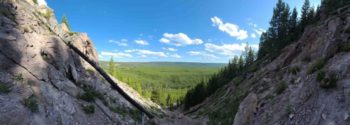
Henderson is a graduate of Westminster College and Idaho State University with degrees in Geology. Her undergraduate research examined the geomorphic and tectonic evolution of Idaho’s Swan Valley. Her current research, with her first PhD publication in preparation, focuses on the .63 million-year-old Yellowstone supereruption, investigating how magma systems are stored and ultimately erupt.
The presentation will be followed by a Q&A period. The informative talks are presented in person on select Wednesdays. The presentations are free and open to the public, with seating on a first-come, first-served basis.
Find Gallatin Valley Friends of the Sciences on social media or visit www.gallatinscience.org for additional details and information about future talks. The nonprofit was established in 2017 to explore cutting edge science topics, their latest developments, and their relevance to society. •