From MSU News Service
When Sean Rogers came to Montana State University in 2015, he had spent more than 11 years of his life on a ship or at a shore facility maintaining communication with ships operating around the Hawaiian Islands.
For roughly six of those years, stationed at Pearl Harbor, the 2003 graduate of Helena High School had an everyday view of the memorial commemorating the 1,177 crew members who died on the USS Arizona during the Japanese attack that drew America into its deadliest war.
And for much of his time serving in the U.S. Navy, after finding that he had a knack for troubleshooting radar, satellite communications and other electronic naval systems, Rogers had the idea that he would one day go to college to study electrical engineering.
“I knew I wanted more, and I felt like electrical engineering would be a perfect fit,” Rogers said. “MSU has provided what I was looking for.”
Scheduled to graduate with his bachelor’s degree this spring, Rogers has excelled academically. But more than that, he said, he has found “a greater purpose” helping fellow veterans at MSU.
“It’s meaningful work, and I see tangible results,” said Rogers, who works part-time at MSU’s Veteran Support Center. There, among other things, he assists the roughly 500 MSU students who receive educational benefits from U.S. Department of Veterans Affairs in exchange for their service. He also works as a math tutor.
The calling to help others is something that Joseph Schumacher, director of MSU Veteran Services, recognizes in veteran students he interacts with every day.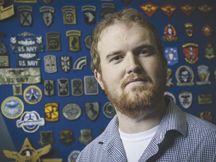
“There’s a mentality that service and giving back don’t stop when you take the uniform off,” said Schumacher, who served in the U.S. Army for 11 years. “I think about that a lot with Sean,” who separated from the Navy as a first class petty officer – a rank considered the leadership backbone of the Navy, Schumacher noted.
For Rogers, what sparked a visit to Schumacher’s office in 2016 was recognizing his own struggles during his first year of college. He grappled with math he hadn’t seen in more than a decade and was learning to manage his own schedule rather than follow a regimented routine. “I knew a lot of other people were having a similar experience with transitioning to civilian life,” he said.
Rogers began working the next semester at the Veteran Support Center, which provides a study and social space in addition to helping students access a range of MSU services such as advising and counseling, as well as other community resources. Shortly thereafter, Rogers also began tutoring math, which he is minoring in at MSU.
“He’s an excellent tutor,” Schumacher said of Rogers. “He combines his expertise with empathy and can take a complex subject and break it down. He understands the challenges that some of our students face.”
According to Schumacher, Rogers also exemplifies the strengths that veterans gain from their military experience but don’t always recognize in themselves: resilience, a strong work ethic and life experience that helps them focus on their studies. Rogers said his time in the Navy also helped him learn how to work with a diverse group of people.
As he begins to look beyond graduation this spring, Rogers said he’s considering graduate school at MSU or a job with the Naval Sea Systems Command, which provides engineering and technical support for the Navy.
For now, when he explains a math concept to a student or helps someone submit their paperwork to get their tuition credit from the VA, “that’s enough reward for me,” Rogers said.
“By giving of himself, without expectation of anything in return,” Schumacher said, “Sean inspires others to give back themselves.”




INDIVISIBLE

Training


040126 BoZone

DOWNLOAD
04-01-26 PDF
BoB 25

Click for Winners!
Bruce Springsteen – Streets Of Minneapolis

The Revolution