Museum of the Rockies is welcoming the new academic year with a full calendar of its own! Here’s a look at some upcoming happenings at your neighborhood museum.
Google Maps Operations Leader, Alysia Andrikopoulos, will present “Lessons from Mapping the World” on Thursday, October 4th in Hager Auditorium at 7pm. Alysia graduated from a Wyoming high school of 14 students. She went on to attend Stanford University and worked in Silicon Valley for more than two decades. She spent eight years working on an industry-altering effort to create Google-owned map data of the world. Alysia will talk about the Google Maps project, some of the challenges involved, as well as lessons learned about leadership and building innovative teams. This event is sponsored by Headwaters Academy and is free and open to the public.
The Gallatin History Museum Lecture Series’ next edition, No More War, No More Plague – The Spanish Influenza Pandemic Toll on Montana with Todd Harwell, will take place Wednesday, October 10th in Hager Auditorium beginning at 6pm.
The presentation will provide an overview of the toll of the Spanish influenza epidemic on Montana communities and the public health response to the pandemic. Harwell is the Administrator of the Public Health and Safety Division in the Montana Department of Public Health and Human Services. He has nearly three decades of experience in this field. Harwell’s lecture is free and open to the public.
MOR is pleased to host the Extreme History Project Lecture Series, encouraging public understanding of the way our history has shaped our present. Speakers take a fresh look at interesting historical topics. Warm Springs are for Healing: Montana’s Hospital for the Insane with Lesley M. Gilmore is next up on Thursday, October 11th at 6pm. The lecture will be held in Hager Auditorium and is open to the public. Sin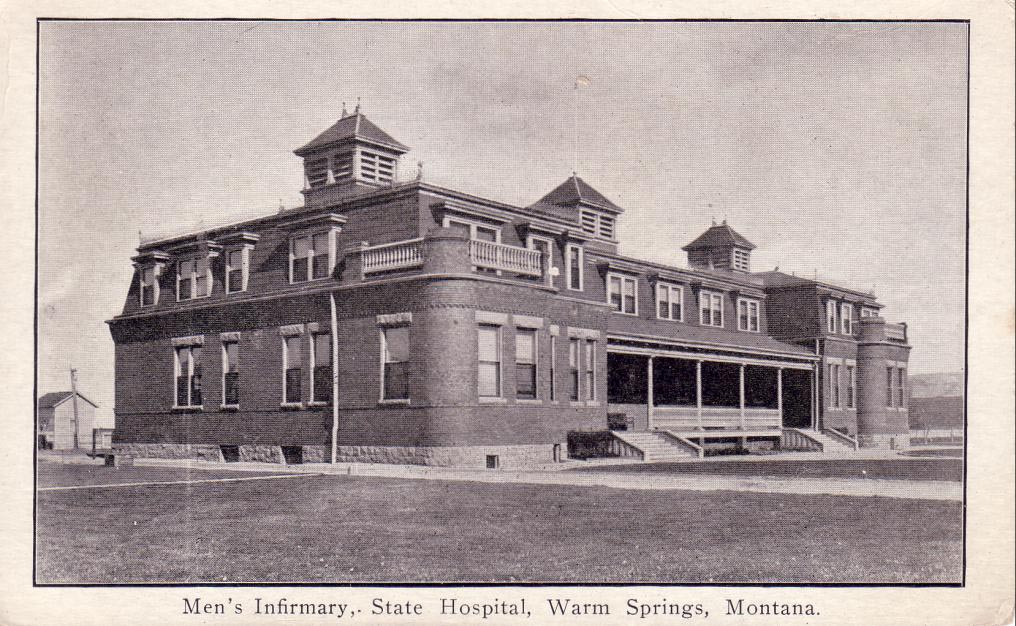 ce its establishment in 1875, the campus at Warm Springs has been put to use towards the palliative treatment of Montana’s insane population. The supervisors transformed what had been a health resort into a hospital dedicated to the care of the “mentally deficient wards” of the state. The changes to the campus reflect the changing trends in mental health care over the years. This was evident in the type, style, and size of buildings. The buildings were like those of many other state institutions – colleges, universities, institute for the deaf and dumb, etc. – and designed by many of the same architects.
Warm Springs was, however, more comprehensive in that it also was self-sufficient for much of its history, with manufacturing and farming considered part of the care for the insane. Work programs were part of the rehabilitation therapy until the 1960s, when they were considered a form of abuse. These programs provided Warm Springs with concrete block and construction thereof, milk, eggs, grains, vegetables, and meat. The property also has a cemetery.
The bucolic setting was typical of state mental institutions, yet has the added distinction of being based at the Warm Springs Mound, a calcite geothermal formation like that of the Elephant Mound in Mammoth Hot Springs of Yellowstone National Park. This mound was earlier a sacred site for the indigenous population and is now again respected (as a restricted National Register property) for its significance to the many Native American tribes who used the area during late prehistoric and historic times.
The perceived curative effect of the thermal properties was the basis for locating first the resort and then the hospital there. Originally, the 180-degree water was distributed to all the hospital buildings. The Warm Springs hospital still focuses – in reduced capacity since distributed clinical care was instituted in the 1960s – on individualized recovery programs to help patients transition back into to the community. The hospital has served the state for over 140 years and remains the only public psychiatric hospital in the state.
The next edition of this season’s Science Inquiry Lecture Series, Journey from the Center of the Sun with Dr. Loren Acton, will take place Wednesday, October 24th in Hager Auditorium beginning at 7pm. This presentation is open to the public.
How does the sun work, and how do we know? Dr. Acton, MSU Research Professor of Physics Emeritus and space shuttle astronaut, will describe how scientists have used tools to piece together a working model of the sun from its very center to its influence on Earth – and how his eight days of solar observations on space shuttle Challenger contributed to the picture.
At each month’s Science Inquiry Lecture, explore cutting edge science topics, their latest developments, and their relevance to society through speaker presentations followed by a Q&A session.
Museum of the Rockies’ popular series Brews & the Big Sky: Montana Made, Montana Brewed continues with Historical Firearms featuring Neptune’s Brewing on Tuesday, October 30th from 5:30–7:30pm. There is a $12 admission including beer tasting, gallery talks, exhibits, and light appetizers for those 21 and older.
Examine some of the famous and infamous firearms from MOR’s collection. From pistols to military weapons, learn about the role that the worldwide Industrial Revolution played in the design and manufacture of firearms in the United States and beyond.
Additional Brews evenings this season will include Charlie Bair of Martinsdale, the Wool King with Bayern Brewing on Nov. 27th; Big Teams in the Big Sky with Great Northern Brewing Company on Feb. 26th; Silver City to the Copper Kingdom with Muddy Creek Brewery on March 26th; and Crow Fair with featured brewer TBA closing out the series on April 30th.
Also at the Museum, two NEW exhibits for fall! Photo exhibition Polar Obsession and multi-media Into the Arctic are now open. Both are included with Museum admission and will be on display through January.
For more information about these events and other Museum exhibits, visit www.museumoftherockies.org or call (406) 994-5257.